
Getting Started With Logic of English

Choose between our two main curriculum lines.
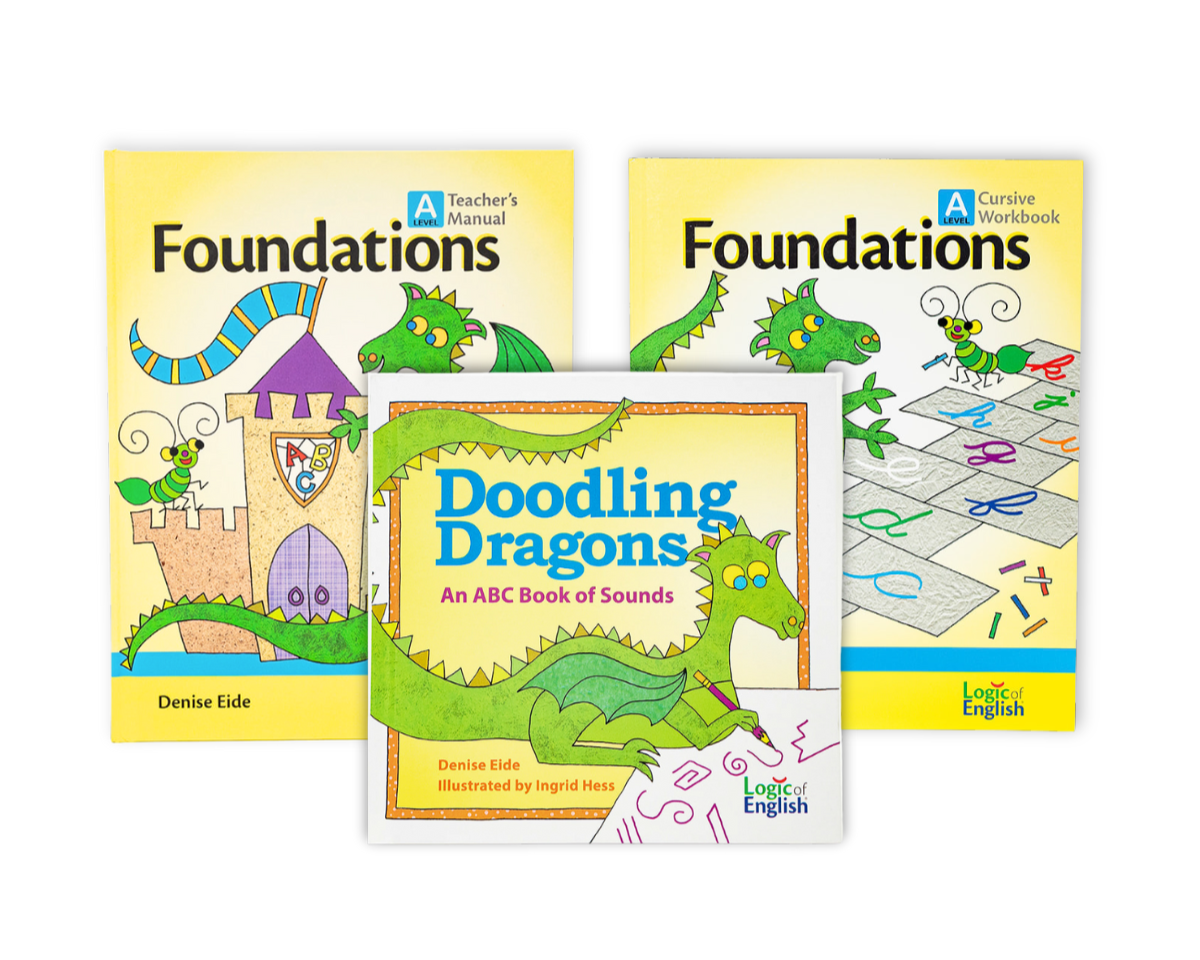
  • Foundations A Bundle

    Foundations

    Phonics, spelling, vocabulary, grammar, and handwriting curriculum typically recommended for young learners working on the foundational skills of reading. Foundations features a fun and playful style of learning.

  • Essentials 1-7 Bundle

    Essentials

    Phonics, spelling, grammar, and vocabulary curriculum designed for older, striving readers. Focuses on improving reading and spelling through research-based lessons and engaging activities.

1 of 2

Determining Your Starting Point

Because our curriculum is based on skill rather than grade level, our placement tests are a great way to find where your student should begin.

Sample Lessons & Scope and Sequence

Get a feel for how the lessons flow and exactly what your student will learn by exploring the scope and sequences as well as sample lessons.

Getting Started FAQ's

Explore key differences between Foundations and Essentials.

What if I am still undecided between Foundations A and Foundations B after using the Starting at Foundations B Assessment?

The Starting at Foundations B Assessment is designed to help you evaluate your learner’s fluency with the concepts introduced in Foundations A. If your learner is only missing a few of the assessed skills from Foundations A – for example, they do not know some of the second and third phonogram sounds, or they need additional practice to blend 4- and 5-sound words fluently – you may decide that, with some review, Foundations B may be a good fit for your learner. The Foundations B Teacher’s Manual includes a section titled “Starting With Foundations B,” which will help you reinforce those skills before jumping into the first Foundations B lesson. Foundations B lessons also provide ongoing opportunities to review and practice the skills introduced in Foundations A.

However, many learners may benefit from moving through Foundations A first for a more comprehensive review. If you decide Foundations A is a better fit for your learner but find that some of the content is familiar, you might consider adjusting the pace. You may also enjoy some of the suggestions found in our Help Center article Increase the Challenge of Foundations!

How can I decide between Essentials Levels if I’m still uncertain after using the Essentials Placement Test with my learner?

As you consider the results of the Essentials Placement Test, we recommend using our Essentials Scope & Sequence to compare Level A, B, and C Spelling Analysis lists and vocabulary content and help you determine which level might be the best fit. Be sure to look at some units from later in Essentials! Spelling and vocabulary concepts become more complex as new phonograms are introduced, so your learner may find later units to be more challenging, even if the first few units feel easier. (For example, Level A Spelling Analysis includes words like bag and soft in Unit 1, but learners will be spelling wheat and toothbrush by Unit 8!)

Also, because all levels of Essentials learners are taught the same phonics and spelling concepts in each Unit, you always have the option to pull Spelling Analysis words from a higher level to add an extra degree of challenge for your learner as you move through Essentials.

What do I need if I will be using Logic of English with multiple learners?

If you are using either Foundations or Essentials with more than one learner, we recommend that you consider:

  • Which consumable items will you need for each learner? Foundations and Essentials learners will each need their own Student Workbooks. Essentials learners will each need a Spelling Journal.
  • Do you want your learners to share other volume-specific items, like Readers or Essentials Morpheme Flash Cards, or would you prefer each learner to have their own copy?
  • Which core materials might be shared between your learners, and which would you like each learner to have?
    (For example, we often see one set of Basic Phonogram Flash Cards shared, while each learner has their own Phonogram Game Tiles.)

    Tip: Many core materials will be used throughout Foundations and Essentials. If you plan to use both Foundations and Essentials, compare the items from each Core Materials Set to determine which items you’d like to purchase and avoid any unwanted duplicates.

    If you’re still not sure what to purchase, feel free to contact our Support team! We would be happy to share additional suggestions or build a custom draft order with the materials you’ll need.

For more information on using Logic of English in the classroom or hybrid setting, visit:

How does your curriculum compare to other programs we’ve considered or used previously?

We are happy to share that our complete Foundations and Essentials Scope & Sequence documents are available online, for free!

Foundations Scope & Sequence
Essentials Scope & Sequence

We recommend using these documents to compare the skills and concepts introduced in our curriculum to other programs you may have explored or the content to which your learner has previously been introduced.

We also offer free downloadable samples of each of our Teacher’s Guides, Student Workbooks, and Readers, which are often helpful for comparison purposes! You can find links to these samples in the “Sample Lessons” drop-down located beneath each product description.

How many volumes of Foundations or Essentials should I plan to move through in a year?

We understand that pacing through any curriculum largely depends on the individual learner. Whether you are using Foundations or Essentials, our materials are designed to be flexible. You may find that you decide to adjust your pace through the lessons over time, depending on whether your learner needs additional practice and review or is ready to introduce new content more quickly!

However, we most commonly see Foundations users move through one or two volumes in a school year, while Essentials users often move through one or two volumes per semester.

For more specific recommendations about pacing, visit our Help Center:

Typical Pace Through Foundations
Essentials Schedules

Additional Products

Use these alongside our curriculum, to supplement instruction, or to strengthen skills.

Rhythm of Handwriting Manuscript Set: Student Workbook, Quick Reference, Student Whiteboard, Desk Strip, and Tactile Cards

Teach Students to Develop Fluid, Legible Handwriting

Rhythm of Handwriting is designed to introduce emerging writers to the cadence of handwriting through explicit, systematic instruction. Available in Manuscript and Cursive.

*Note: Those using Foundations do not need to purchase Rhythm of Handwriting. The same instruction in our Rhythm of Handwriting is provided in Foundations lessons. Rhythm of Handwriting is designed to be used alongside Essentials or as a stand-alone writing program.

Game Book Bundle

Phonics, Reading, Spelling, and Vocabulary Games for All Ages

From board games to high-energy activities, the Logic of English Game Book Bundle contains hundreds of phonogram, reading, and spelling games that strengthen literacy skills, segmenting and blending skills, and phonemic awareness skills.

The Game Book can be used alongside Logic of English curriculum or used as a stand-alone to strengthen skills. The games and activities are great for one-on-one or group settings.

Sounding Out the Sight Words: An Alternative to Rote Memorization

Explain Sight Words Logically with Short, Interactive Lessons

Introduce students to systematic phonics rules that explain the logic behind 95% of sight words! Sounding Out the Sight Words includes:

  • 67 short lessons that explain the 315 Dolch words
  • Phonograms and spelling rules that unlock tens of thousands of words
  • Easy-to-follow directions for teachers 
  • Student practice pages 
  • Game suggestions from the Logic of English Game Book

Use Sounding Out the Sight Words as a stand-alone program, a supplement to your ELA curriculum, or a combination of both.

  • Uncovering the Logic of English®: A Common-Sense Approach to Reading, Spelling, and Literacy written by Denise Eide

    Uncovering the Logic of English

    Uncovering the Logic of English challenges the notion that English is illogical by revealing the logical patterns underlying 98% of English words.

  • How Your Brain Learns to Read

    How Your Brain Learns to Read

    How Your Brain Learns to Read introduces children to the neuroscience of reading and walks teachers and parents through a series of facts that helps them to support young students.

  • Make It Make Sense: Morphology book

    Make It Make Sense: Morphology

    This book not only introduces students to morphology concepts like prefixes, suffixes, and roots, but it also serves as a visual guide to over 50 of the most common morphemes.

1 of 3

Need help deciding which curriculum is the right fit?

Our Curriculum & Customer Support Advocates can help!

student doing spelling analysis online

Contact Us

We look forward to learning more about your needs!